Everyday operations in restaurant chains involve countless difficult decisions. One good example is determining how many burgers to prepare: too few leads to weaker-than-expected cash flow during rush hours, while too many result in waste. When this problem repeats across hundreds of restaurants and dozens of products, the cumulative effects are immense.
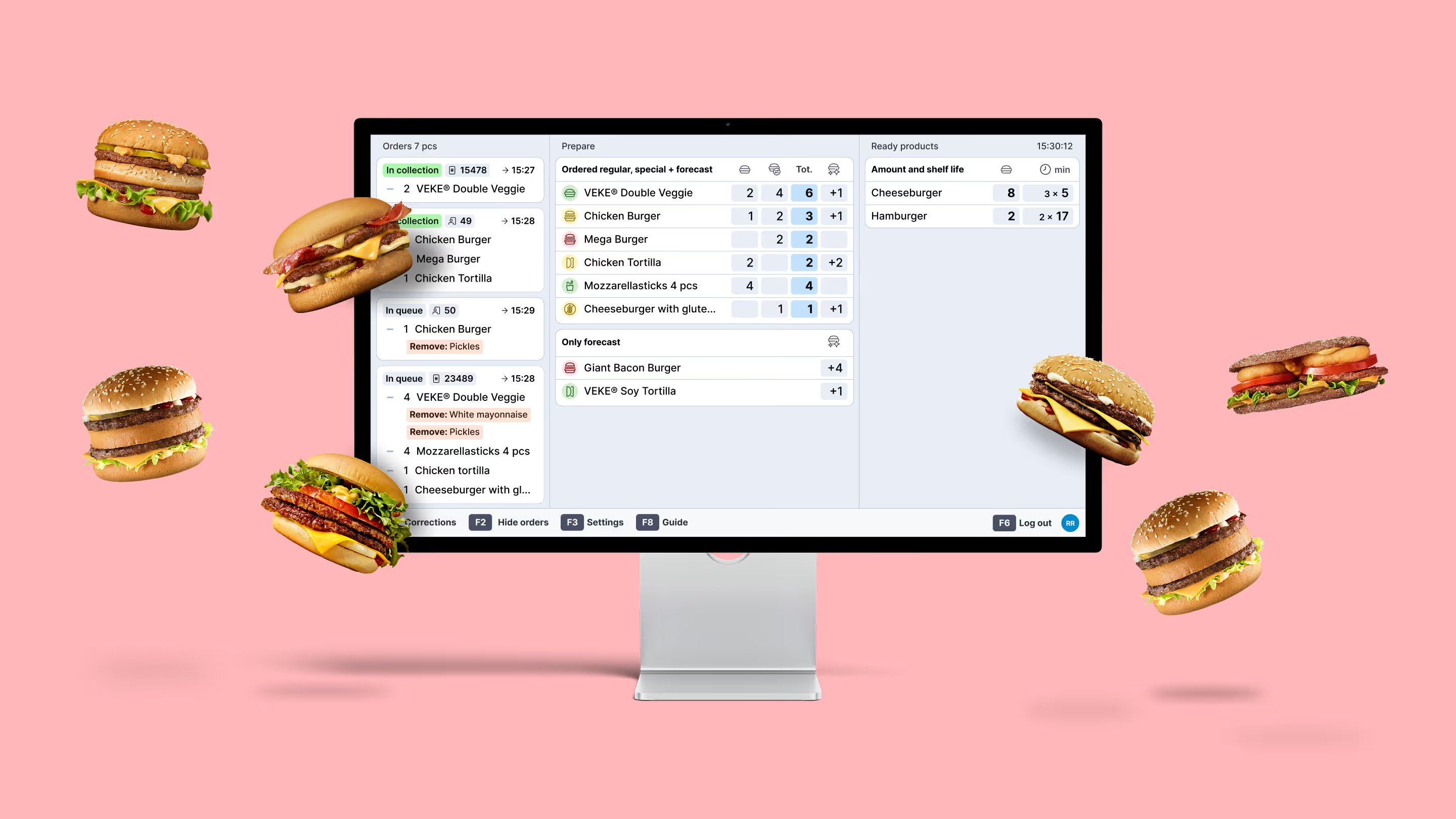
The Fast Food Forecaster we developed for Hesburger demonstrates how an organisation’s tacit knowledge can be turned into usable data. Machine learning can offer companies more accurate forecasts, making it easier to make reliable decisions. In a growing international business, this carries considerable strategic weight. From a restaurant employee’s perspective, the forecast functions like an assistant, telling them how many of each product to prepare.
Professionals in the restaurant industry possess a great deal of tacit knowledge. An experienced restaurant manager knows which evenings tend to be quieter, how events and holidays affect sales, and how much of each product is typically sold during a given period.
However, information that exists only in people’s minds is not very useful for business planning. In the past, solutions have relied on historical averages. Adding tacit knowledge to that brings us closer to reality: without understanding everyday variables, forecasts are like weather reports based solely on a thermometer reading. The goal of the Fast Food Forecaster is to incorporate this intuitive expertise into a predictive, guided machine learning model.
We began by training the model on a large sales dataset. It learns to identify patterns that are difficult for humans to detect. From the start, we have emphasised the importance of traceable decision-making: the model is not a black box but a transparent tool that can explain the logic behind its conclusions when needed.
What does supervised machine learning mean in this project in practice? Put simply, the algorithm is fed a large number of examples (“On Tuesday, we sold six cheeseburgers within a given time window while the October campaign was active”) from which it gradually builds a network of rules and applies them.
Sales forecasting is, at its core, a classic regression problem in statistics. Traditional linear regression assumes that if lunchtime increases sales by ten units and a campaign by five, together they will increase sales by fifteen. Since restaurant sales are far more complex in reality, a non-linear method is needed – one that can recognise interactions where the impact of one variable depends on the values of others.
For example, consider the following chain of questions:
“Is it lunchtime?” → Yes
“Is it a weekday?” → Yes
“Is it October?” → Yes
“Is there an active campaign?” → No
Result: Four cheeseburgers sold in similar situations.
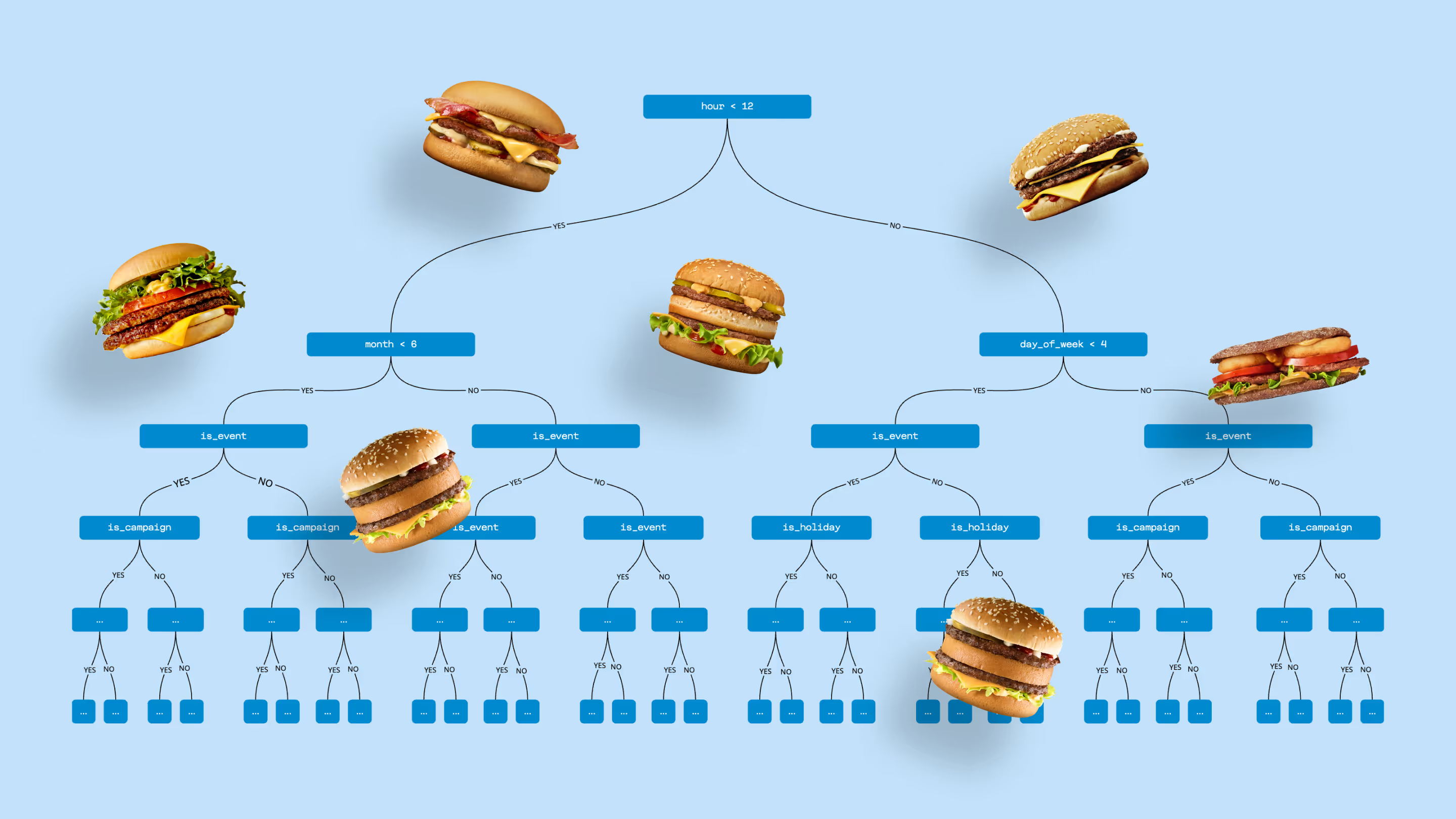
To work effectively, the model must construct hundreds of such decision trees. Some focus on the time of day, others on events or the season. The final forecast is a synthesis of all these results.
Why does this approach work better than traditional methods? Time series forecasting examines how things change over time. The aim in restaurant sales is to uncover both regular patterns and anomalies. Decision trees are a useful tool for modelling complex interactions. They can learn, for instance, that “Tuesday + lunchtime + campaign = 150% of normal sales”, even if each factor alone has a smaller effect.
The Fast Food Forecaster does not replace people. It serves as an assistant for restaurant staff, helping them make better decisions faster and more accurately than ever before.
The journey has only just begun: the first version of the model continuously gathers feedback and learns to recognise increasingly complex cause-and-effect relationships.
From a business perspective, the Fast Food Forecaster scales effortlessly alongside rapid growth. The model adapts its training to match demand, whether it’s for one restaurant or a hundred – each with its own unique operating environment. Above all, it transforms decision-making from reactive to proactive.